
We've all heard it before.
"Back in my day, interest rates were 18%! You young blokes don't know how good you've got it!"
And to all my Uncle Barries out there who survived the 1980s, firstly, congratulations. I genuinely mean that. Paying a mortgage with interest rates approaching 18% would have been absolutely brutal.
But here's something I've been thinking about lately.
What if today's homebuyers are actually facing an affordability crisis that's just as challenging, or in some ways even worse, than what Australians experienced in the late 1980s?
Because while interest rates might be considerably lower today, the amount of money we're borrowing relative to what we're earning is a completely different story.
So rather than arguing over who had it harder at the next family barbecue, I thought we'd actually look at the numbers.
And they're pretty interesting.
The 1980s: When Mortgage Interest Rates Hit 17%
Let's wind the clock back to 1989.
Inflation was running hot, interest rates were climbing, and Australian households were feeling the pressure.
According to the Reserve Bank of Australia, standard variable mortgage rates reached approximately 17% in 1989. The often-quoted 18% figure is closer to the peak cash rate experienced during that period, rather than the standard mortgage rate.
Still, 17% is enormous.
But here's where things get interesting.
According to historical RBA figures, the average new Australian owner-occupier mortgage in 1989 was approximately $67,495.
Meanwhile, average weekly ordinary-time earnings were around $510, or approximately $26,500 annually before tax.
Let's do some maths.
For a $67,495 mortgage at 17% interest over 25 years, the repayments would have been approximately:
$970 per month.
That might not sound like much today, but remember, we're talking about someone earning roughly $2,200 a month before tax.
That means mortgage repayments represented approximately 44% of one average full-time gross wage.
That's a serious financial commitment, particularly when you still need to pay for food, utilities, transport and everything else.
So yes, Uncle Barry, I'll absolutely give you that one. It was tough.
Fast Forward to 2026: Interest Rates Are Lower, but Mortgages Are Enormous
Now let's look at what Australian homebuyers are dealing with today.
According to the Australian Bureau of Statistics, the average new owner-occupier mortgage nationally reached approximately $736,000 in the September quarter of 2026.
In Victoria, the average was approximately $669,000.
Average full-time weekly ordinary-time earnings nationally, meanwhile, were approximately $2,084 as at May 2026.
That's approximately $108,400 per year before tax.
For our comparison, let's use a 6.5% mortgage interest rate and the same 25-year loan term.
On the national average mortgage of $736,000, repayments would be approximately:
$4,970 per month.
And on an average full-time wage of around $9,030 per month before tax?
Those repayments represent approximately 55% of gross earnings.
Hold on a second.
In 1989, with mortgage rates at 17%, repayments were around 44% of an average full-time wage.
Today, at just 6.5%, they're approximately 55%.
That doesn't exactly sound like we've got it easy, does it?
The Mortgage Affordability Comparison (1989 vs 2026)
Here's how the two periods stack up using national lending and wage data.
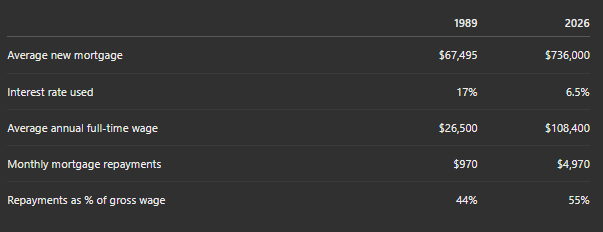
Figures are rounded. Repayments assume principal and interest over 25 years. The historical loan series includes refinancing, whereas the modern series excludes it. Earnings are national averages, not household incomes, and the calculations are before tax.
The biggest takeaway for me isn't necessarily the mortgage repayment itself.
It's just how much larger our mortgages have become relative to our incomes.
In 1989, the average mortgage represented approximately 2.5 times an average annual full-time wage.
Today, that figure is approximately 6.8 times.
And that's a significant difference.
What About Melbourne House Prices?
Let's bring this a little closer to home.
In Melbourne, the median house price in 1989 was approximately $132,000.
By the June quarter of 2026, the median Melbourne house price was approximately $952,500, according to the Real Estate Institute of Victoria.
When we compare those figures against the same national average full-time wage measure, something stands out.
In 1989, the median Melbourne house cost approximately five times an average annual full-time wage.
Today, it's approximately 8.8 times.
In other words, house prices have increased considerably faster than average wages over that period.
And it's not just about having enough income to make the repayments.
Think about saving a deposit.
A 20% deposit on a $132,000 house in 1989 was $26,400.
A 20% deposit on a $952,500 house today is $190,500.
That's before stamp duty, conveyancing, inspections and other purchasing costs.
Yes, there are various first home buyer schemes available today that can reduce the deposit required. But the underlying challenge remains.
Getting into the housing market has become incredibly expensive relative to what Australians earn.
Now, there's something important worth acknowledging.
If we take a median-priced Melbourne house in each period, assume a 20% deposit and calculate repayments at the respective interest rates, the 1989 borrower actually had a higher initial repayment burden relative to wages.
So I'm not suggesting every affordability measure favours today's argument.
What I'm saying is that looking at interest rates alone tells us very little about how affordable housing really is.
It's Not Just About Interest Rates. It's About Debt.
This is the part of the discussion I think often gets overlooked.
In the late 1980s, interest rates were extraordinarily high, but mortgage debts were much smaller.
Today, interest rates are relatively modest by historical standards, but household mortgage debts are substantially larger.
That means even a relatively small movement in interest rates can have a significant impact on household budgets.
And we're seeing that play out.
In fact, research published by KPMG in July 2026 found that Australian households had experienced a heavier interest repayment burden in recent years than during the late-1980s interest rate peak.
According to KPMG, household interest repayments averaged 5.8% of household income between September 2023 and March 2025, compared with approximately 5.6% during the 1989–90 period.
It also found Victorian households were carrying the highest interest burden nationally.
These figures measure interest payments across households, rather than the repayments of an individual new homebuyer, but they reinforce an important point.
You don't need 17% interest rates to create the same sort of financial pressure when debt levels are substantially higher.
There is, of course, another side to this.
Borrowers in the late 1980s faced an extraordinarily difficult period of inflation, high interest rates and, shortly afterwards, a recession that saw unemployment rise sharply.
None of that should be dismissed.
But equally, I don't think we should dismiss the challenges facing today's first home buyers and younger families simply because their mortgage interest rate starts with a six rather than a one.
So, Is Housing Less Affordable Today Than It Was in the 1980s?
I think it depends on what we're measuring.
If we're talking about the difficulty of saving a deposit or buying a house relative to income, today's buyers are facing a much steeper challenge.
If we're looking at the average new mortgage relative to one full-time wage, repayments are also taking up a larger share of income in our comparison.
But if we're comparing the immediate repayment burden of a buyer purchasing a median-priced Melbourne house with an 80% loan in 1989, that borrower faced a particularly punishing situation.
The important distinction is that housing affordability is about more than interest rates.
It's about house prices, debt levels, incomes, deposits, repayments and the financial flexibility households have left after servicing their mortgage.
And I think that's something worth remembering the next time we hear how easy today's homebuyers supposedly have it.
But Here's Why I'm Still Optimistic About the Future
Now, I don't want this to be another one of those depressing articles about how impossible everything has become.
Because despite all the challenges, I actually think there's reason to be hopeful.
Australians who bought homes in the late 1980s experienced some incredibly difficult years.
But over time, mortgage rates fell substantially, wages increased, and many homeowners gradually found their financial position improving.
Of course, that wasn't everyone's experience, and there were households that suffered tremendously through the recession.
Still, it reminds us that the financial conditions we experience today aren't necessarily the conditions we'll experience forever.
And that's something I often discuss with clients.
When you're taking on a mortgage, particularly your first mortgage, those first few years can be the most financially demanding.
Your loan balance is generally at its highest, and you're adjusting to a significant new commitment.
Over time, however, there are opportunities for things to improve.
Your income may grow. You may reduce your loan balance. Your career might progress. And at some point, interest rates may fall, although there's certainly no guarantee of when that will happen.
The important thing is making sure your finances can withstand the conditions we're experiencing today rather than relying on future improvements to make the numbers work.
Because if you can comfortably manage your mortgage through challenging conditions, you're putting yourself in a much stronger position to benefit when things improve.
That's the approach I believe in.
Not just getting someone approved for a home loan, but helping them understand their borrowing capacity, structure their mortgage appropriately and build a financial position that works for the long term.
My Final Thoughts
I have enormous respect for Australians who bought property during the late 1980s and survived those extraordinary interest rates.
But I also have enormous respect for young Australians trying to enter the property market today.
Neither generation has had it easy.
The challenges have simply changed.
Back then, it was extraordinarily high interest rates on relatively smaller mortgages.
Today, it's significantly larger mortgages, house prices that have outpaced wages, and substantial financial commitments even at comparatively lower interest rates.
So perhaps instead of arguing about which generation had it harder, we should acknowledge that both have experienced genuinely difficult housing markets.
And to the younger Australians doing everything they can to buy their first home or manage their existing mortgage, don't lose heart.
The 1980s eventually passed, and so will today's economic conditions.
That doesn't mean property prices will automatically become affordable or that mortgage rates are guaranteed to fall.
But it does mean that today's challenges don't have to define your financial future.
And sometimes, getting through the difficult years with a sensible plan is exactly what puts you in a position to thrive in the years that follow.
